
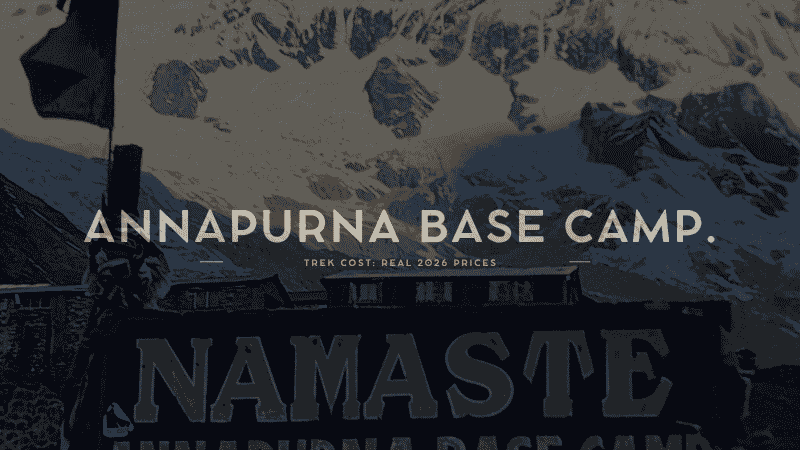
We get some version of "how much does ABC actually cost" almost every week, usually from someone who's already spent an hour scrolling through five different trekking sites and come away more confused than when they started. It's a fair reaction. Type "Annapurna Base Camp Trek cost" into Google and you'll find quotes anywhere from under $400 to well over $1,500, all supposedly for the same trek to the same 4,130m amphitheater of mountains. Nobody explains why the numbers are so far apart, so people assume either the cheap operators are cutting corners or the expensive ones are ripping them off. Sometimes that's true. More often, the honest answer is that "the ABC trek" quietly means several different trips, and the price tag is telling you which one you're actually looking at.
Hand-picked itineraries
Recommended Trips
Related journeys you may want to explore after reading this article.
.jpg)
.jpg)
-1.jpg)
So let's take the guesswork out of it. Below is a real, itemized look at what this trek costs in 2026 — not a marketing range, but the actual numbers behind our own packages, broken down by route, tier, and group size, plus the costs that never show up in the headline price no matter who you book with.
The Short Answer, If You're in a Hurry
For the 7-day fast-paced route out of Pokhara, budget USD 450 for a no-frills package or USD 880 for a fully-served Standard package, traveling solo. For the classic 11-day route that starts and ends in Kathmandu, Standard pricing runs USD 1,099 solo, dropping to somewhere between USD 750 and 950 per person once you're trekking with a group. Both itineraries end up in the same place — Annapurna Base Camp itself — so the price difference isn't about the destination. It's about how much trail, culture, and comfort surrounds getting there.
Why the Range Is So Wide in the First Place
Three things do almost all the work in explaining the spread you'll see online.
The first is duration. A 7-day fast-paced itinerary and the fuller 11 to 12-day classic loop through Ghandruk and Chhomrong are, honestly, two different trips wearing the same name. More days on the trail means more guide-days, more porter-days, more teahouse nights — and all of that shows up in the final number.
The second is package tier. A Budget package typically covers your permits, your guide, and a bed in a teahouse — nothing more. A Standard package adds every meal, city hotels in Pokhara or Kathmandu, and a porter to carry the weight you'd otherwise be hauling yourself. Neither is dishonest; they're just answering different questions about what you want handled for you.
The third, and the one people underestimate most, is group size. A guide's daily wage doesn't change whether they're leading one trekker or six. Neither does the cost of a permit-processing trip to the tourism office, or hiring a jeep to the trailhead. Those costs get divided across however many people are actually on the trip, which is why solo travelers consistently pay more per person than the same itinerary booked with a couple of friends.
7-Day Fast-Paced ABC Trek (Pokhara-Based)
This is the route for people who want Annapurna Base Camp without a two-week commitment. It skips the long approach through Ghandruk and drives straight to Jhinu Danda, saving two full trekking days without cutting the destination, Chhomrong (the last real village before the high sanctuary), or the hot springs at Jhinu that most trekkers are grateful for on the way back down.
| Group Size | Budget Package | Standard Package |
|---|---|---|
| 1 Person (Solo) | US$ 450 | US$ 880 |
| 2 People | US$ 400 | US$ 850 |
| 3–7 People | US$ 370 | US$ 830 |
| 8–12 People | US$ 340 | US$ 800 |
| 13–20 People | US$ 320 | US$ 790 |
The Budget tier gets you twin-share teahouse lodging, local bus or jeep transport between Pokhara and the trailhead, a licensed English-speaking guide, your ACAP permit and TIMS card, a pre-trek briefing, and a basic first-aid kit. What it doesn't cover is almost everything you'll actually eat or sleep in outside the trail itself — no meals, no Pokhara hotel, no porter, no insurance.
Standard closes most of those gaps for roughly USD 430 more: a night in a 3-star Pokhara hotel with breakfast, every meal on the trek (breakfast, lunch, dinner, and hot drinks — somewhere around 18 meals over the week), a porter, private jeep transfers instead of shared local transport, and a first-aid kit that includes a pulse oximeter, which your guide will actually use to keep an eye on how you're acclimatizing.
11-Day Classic Route (Kathmandu-Based)
This is the trek as it was walked before shortcuts existed — starting and finishing in Kathmandu, with a cultural sightseeing day built in, and following the traditional approach through Ghandruk, the largest Gurung village in Nepal and one of the more memorable overnight stops on any Annapurna itinerary.
| Group Size | Price Per Person |
|---|---|
| 1 Person (Solo) | US$ 1,099 |
| 2 People | US$ 950 |
| 3–7 People | US$ 850 |
| 8–12 People | US$ 780 |
| 13–20 People | US$ 750 |
That price is genuinely all-in: two nights in a 3-star Kathmandu hotel, two nights in Pokhara, breakfast at both, every trek meal, the tourist bus between Kathmandu and Pokhara, private jeep transfers to and from the trailhead, your guide, a porter shared between every two trekkers, both permits, and the same altitude-monitoring first-aid kit as the Standard 7-day package.
The Costs That Never Make It Into the Headline Price
This is the part almost nobody budgets for properly, and it's the same handful of things regardless of which package or duration you choose:
International flights and your Nepal visa fee (USD 30 for a standard single-entry visa on arrival) are always separate. So is travel insurance — and we'd push back gently on anyone tempted to skip this one. You want a policy that explicitly covers trekking above 4,000m and helicopter evacuation, not just general travel insurance with the fine print unread. It typically runs USD 100–200 for the trip and is, frankly, the cheapest peace of mind you'll buy in Nepal.
Personal gear is optional to bring from home — Pokhara has plenty of rental shops if you'd rather not fly with a duffel bag of trekking equipment. Hot showers, Wi-Fi, and charging your phone at teahouses cost a few dollars each time you use them, and they get pricier and less reliable the higher you climb; don't expect much above Deurali. And then there are tips, which are customary rather than optional in practice — most trekkers budget USD 15–20 a day for their guide and USD 10–15 a day for their porter.
Add it up and most people should plan for another USD 300–500 on top of whatever package price they booked, once insurance and tips are accounted for. Treat the number on the website as your logistics cost, not your total trip cost — that gap is where a lot of trekkers get caught off guard.
If You'd Rather Fly Out Than Walk Down
Not everyone wants to retrace four days of descent on tired knees, and we don't blame them. A helicopter return from Annapurna Base Camp straight to Pokhara has become a popular upgrade, often paired with a better hotel category and sometimes a tandem paragliding flight over Phewa Lake thrown in for good measure. It's not cheap — a private helicopter charter is a serious fixed cost even split across a small group — so expect somewhere in the USD 1,200–1,500 per person range depending on group size. But if time is tighter than budget, it buys you an extra couple of days back.
How ABC Stacks Up Against Everest and Manaslu on Price
If you're weighing this against Everest Base Camp or the Manaslu Circuit, ABC usually wins on cost, and by a meaningful margin. Everest requires a flight to Lukla, which is its own line item and comes with real weather-delay risk that can quietly add an unplanned hotel night or two in Kathmandu. Manaslu needs a Restricted Area Permit on top of the standard conservation fee, running an extra USD 75–100-plus per week. ABC needs neither — just the ACAP permit and a TIMS card — and the entire route is reachable by road from Kathmandu or Pokhara. For a comparably dramatic high-altitude experience, it's consistently the more affordable of the three.
A Few Honest Ways to Bring the Cost Down
If budget is the deciding factor, the 7-day Pokhara route gets you to the same base camp as the 11-day classic version, just with fewer days either side of it — a sensible trade if time matters more to you than the extra villages along the way. Trekking with even one other person meaningfully lowers your per-person rate, so it's worth asking around before assuming you have to go solo. And if you already own suitable gear, bringing it beats renting, even after the extra baggage weight.
Where we wouldn't recommend cutting: skipping travel insurance, or turning down a porter because you're trying to save a hundred dollars and you're not used to carrying a loaded pack at altitude. Both of those savings tend to cost more than they save, one way or another.
As a private-departure operator, every quote we send is itemized around your actual dates and group size — never a fixed departure rate padded to cover seats that didn't sell.
Want an exact quote for your dates? See our Annapurna Base Camp Trek packages — tell us your group size, dates, and which route length you're leaning toward, and we'll send back real, itemized pricing, not a ballpark.
FAQ
What is the average cost of the Annapurna Base Camp Trek? For the 7-day route, expect USD 450 (Budget) to USD 880 (Standard) solo. For the fuller 11-day classic route, Standard pricing runs USD 750–1,099 per person depending on group size.
Does the ABC trek cost include permits? Yes — the Annapurna Conservation Area Permit (ACAP) and TIMS card are included in every package tier, budget or standard.
Is travel insurance really mandatory for the ABC trek? It's never bundled into the package price, but yes, practically speaking it's essential — insurance covering altitude above 4,000m and helicopter evacuation given the terrain and altitude reached at base camp.
Is Annapurna Base Camp cheaper than Everest Base Camp? Generally yes — ABC needs no domestic flight to reach the trailhead and no restricted-area permit, both of which add significant cost to an Everest Base Camp trip.
How much should I budget for tips on the ABC trek? Customary rates are USD 15–20 per day for your guide and USD 10–15 per day for your porter, paid at the end of the trek.