

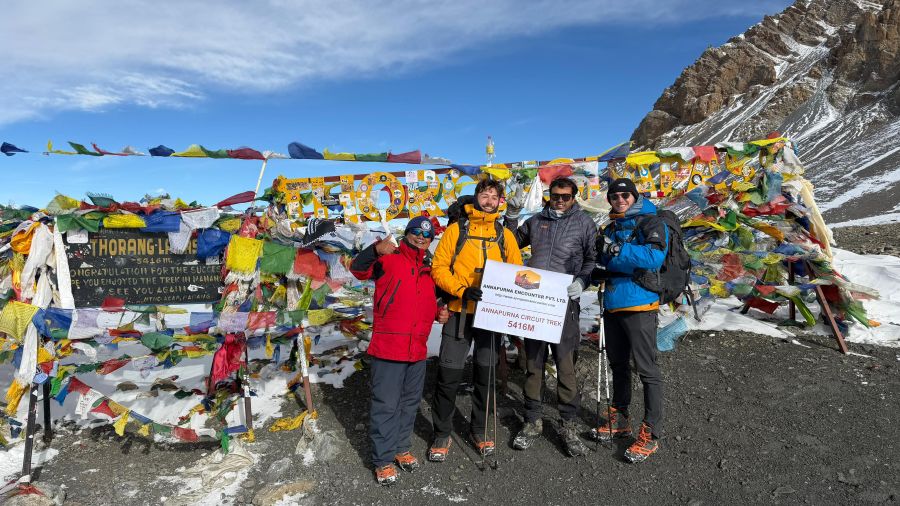
The Annapurna Circuit trek in October delivers something no other month can match: air scrubbed clean by months of monsoon rain, revealing Himalayan panoramas with almost unreal clarity.
Hand-picked itineraries
Recommended Trips
Related journeys you may want to explore after reading this article.

Peak Season Callout: October and November together account for nearly 40% of annual trekkers in the Annapurna region (Nepal Ministry of Culture, Tourism & Civil Aviation), and the reason is straightforward — conditions are simply as good as they get.
The monsoon's legacy is counterintuitively generous. From June through September, heavy rainfall scrubs dust, pollutants, and particulate matter from the atmosphere. By the time October arrives, that cleansing effect produces crystalline visibility — the kind where the Dhaulagiri and Annapurna massifs appear close enough to touch, their snow-capped ridgelines sharp against deep blue skies.
Weather stability is equally compelling for high-altitude crossings. Daytime temperatures at lower elevations like Besisahar average a comfortable 68–77°F (20–25°C) in October, while dry, settled conditions at Thorong La Pass (5,416m) make the crossing genuinely manageable rather than a gamble — something the unpredictable winter months simply can't guarantee.
The social dimension shouldn't be overlooked either. Trail teahouses are fully staffed, routes are well-monitored, and the camaraderie among fellow trekkers creates an energetic atmosphere. However, if solitude is a priority, the season's popularity is worth factoring in before booking. Spring, with its own distinct appeal, offers a quieter — and equally beautiful — alternative worth exploring.
The Spring Alternative: Rhododendrons and Rising Temps
Spring offers a genuinely compelling case for the best time to trek Annapurna Circuit — just a different kind of compelling than October's crystalline skies.
The defining spring advantage is botanical. According to the Nepal Tourism Board, March through May is the only window to witness Nepal's national flower, the rhododendron, in full bloom at lower elevations — a cascade of red, pink, and white that transforms the forested lower slopes into something almost surreal.
Autumn clarity vs. spring life — the tradeoff is real:
Rhododendron blooms blanket elevations below 3,500m from late March through April
Wildlife activity peaks in spring, making it the preferred season for birdwatchers and nature-focused trekkers
Longer daylight hours give trekkers more flexibility on approach stages
Fewer crowds on trail compared to the October rush
Warmer nights at lower camps, though high-altitude temperatures remain challenging
However, spring carries a notable caveat: haze. Pre-monsoon atmospheric buildup creates a milky horizon by mid-morning, dulling the panoramic views that autumn delivers so effortlessly. High camps above 4,000m also run colder at night than equivalent October positions.
That atmospheric instability hints at something trekkers targeting the full circuit must weigh carefully — because at 5,416 meters, Thorong La Pass has its own non-negotiable demands regardless of season.
The Thorong La Factor: When the Pass Becomes Impassable
No conversation about the Annapurna Circuit best time is complete without confronting its most critical variable: Thorong La Pass. At 5,416 meters, this is the highest point of the entire route — and the single factor that can make or break your trek.
The pass doesn't negotiate. If conditions turn, you turn back.
According to the Himalayan Rescue Association Nepal, "Thorong La Pass is frequently closed from late December through February due to heavy snowfall and extreme risk of avalanches." That's not a suggestion — it's a hard seasonal ceiling. Winter trekkers who push beyond Manang risk getting pinned down on either side of the pass with no safe crossing.
Even in optimal conditions, the environment punishes the underprepared. The Department of Hydrology and Meteorology (Nepal) records nighttime temperatures at Thorong Phedi dropping to -10°C (14°F) in October — considered the good month. In January, those figures become genuinely dangerous.
Safety checklist for Thorong La crossing:
Start early — summit by mid-morning before afternoon winds build
Acclimatize fully at Manang (minimum two nights)
Monitor weather the evening before — fresh snow signals a postponed crossing
Know your turnaround time — guides typically call it at 11:00 AM if the summit isn't reached
Carry emergency gear including microspikes for icy patches
Beyond the physical challenge, decision-making at altitude is genuinely compromised — a reality worth understanding before comparing high-altitude route options. Timing your trek right is the first layer of safety. Knowing the on-the-ground realities is the second — and that's where most trekkers find out what they didn't plan for.
10 Things I Wish I Knew Before Choosing My Trek Dates
Choosing the best time for Annapurna Circuit trek involves more than picking a clear-sky month — the practical details can make or break your experience.
Teahouse crowding is real in October. Peak season means popular stops like Manang fill up by early afternoon. Book ahead or plan to arrive by 2 p.m.
Buffer days aren't optional. Build at least two extra days into any itinerary. Weather delays, acclimatization needs, and trail conditions all demand flexibility.
Flight cancellations to Jomsom spike in winter. Strong afternoon winds and low visibility make this mountain airstrip notoriously unreliable from December onward. Plan ground alternatives.
The Manang festival adds cultural richness. If your timing aligns, local festivals around Manang offer a rare glimpse into Himalayan village life that no guided tour can manufacture.
Teahouse quality varies wildly by elevation. Higher altitudes mean thinner mattresses and colder showers — pack for the cold nights regardless of your start month.
Permits sell out patterns shift. October sees the heaviest TIMS and ACAP permit queues in Kathmandu — arrive early.
Acclimatization day in Manang is non-negotiable. Skipping it is the single most cited reason trekkers abandon the route before Thorong La.
Mid-October is the sweet spot within the sweet spot. Early October can carry residual monsoon moisture; late October brings colder nights.
The Himalayan Rescue Association Nepal warns that mid-winter renders the circuit's highest point impassable for standard guided groups.
Local intelligence beats any forecast. Teahouse owners and porters know micro-conditions better than any app — something the next section explores in depth.
Advice From the Trail: A Guide's Perspective on Gear and Timing
Knowing the best time to do Annapurna Circuit is only half the battle — how you prepare for the thermal reality on the ground determines whether you thrive or just survive.
The single most critical gear principle: always layer.
According to the Department of Hydrology and Meteorology (Nepal), temperature swings of up to 35°F between midday valleys and pre-dawn high camps are common. In practice, that means a base layer, insulating mid-layer, and a wind-resistant shell need to be accessible within your pack at all times — not buried at the bottom.
Micro-climates matter. The Manang valley, Thorong La's north face, and the Kali Gandaki gorge each behave differently. Local guides read these shifts instinctively in ways no weather app replicates.
Lingering monsoon in early October? Build a 1–2 day buffer into your itinerary near Chame or Pisang. Attempting the pass in residual wet conditions is the most avoidable mistake trekkers make.
Peak-season congestion slows teahouse queues and trail pace significantly. Hiring local porters for high-pass days reduces physical load precisely when altitude stress peaks, and directly supports Gurung and Thakali communities.
One practical approach is treating your itinerary as a framework, not a contract — flexibility, local knowledge, and the right layers give you the margin to respond when the mountain decides the schedule. That mindset also shapes how you choose which month to commit to, which is exactly what the next section breaks down.
The Bottom Line: Which Month is Best for You?
The best time for the Annapurna Circuit depends entirely on your priorities — but every season has a clear winner and a clear trade-off.
October–November is the gold standard for most trekkers. Skies are crisp, Thorong La Pass is reliably open, and the post-monsoon light delivers the kind of mountain photography that ends up framed on walls. Crowds peak in October, but the trail infrastructure handles it well. If a guaranteed pass crossing is non-negotiable, this is your window. Consider pairing it with a combined Circuit and Base Camp route to maximize the season.
March–April suits nature lovers and trekkers who prefer warmer high-altitude days. Rhododendron forests bloom at lower elevations, and the spring shoulder season draws fewer crowds than October while still keeping the pass accessible.
December–February works for cultural immersion at lower elevations. However, Thorong La becomes genuinely dangerous — this window suits village-to-village itineraries, not full circuits.
June–August is monsoon season on the main circuit. Rain-shadow destinations like Upper Mustang stay dry, but the standard Annapurna route is best avoided.
Bold takeaway: no month is universally wrong — but choosing the right one requires matching conditions to your goals. That's where expert itinerary planning makes all the difference.
Navigating the Annapurna Circuit with Annapurna Encounter
The right local partner transforms a logistics puzzle into a seamless Himalayan journey — especially when October crowds, unpredictable passes, and shoulder-season variables are all in play.
Peak-season logistics: October fills teahouses fast. Annapurna Encounter secures pre-booked accommodations along the route, so trekkers avoid the scramble for beds after a long day near Thorong La — a real concern when fixed-departure groups converge on the same teahouse clusters simultaneously.
Professional guides at the pass: At 17,769 feet, Thorong La demands respect in any season. When weather shifts without warning, a seasoned guide reads the conditions, adjusts departure timing, and knows when to turn back — a judgment call that experience, not a guidebook, provides. For off-season crossings, the stakes climb further; winter conditions on the pass make professional guidance essential, not optional.
Shoulder-season customization: Spring and autumn shoulder months reward flexibility. Annapurna Encounter tailors itineraries for botanical trekkers chasing rhododendron blooms or photographers prioritizing low-angle autumn light — pacing the route around what matters most to each group.
Every season on the Annapurna Circuit has a version worth experiencing. The difference is how prepared you are for it. Explore expert-led Annapurna Circuit expedition packages and let local knowledge do the heavy lifting.