
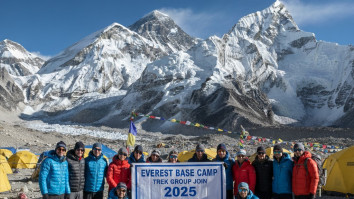
Somewhere between Dingboche and Lobuche, on almost every departure, someone on the trail feels off. A headache that won't lift with paracetamol. Appetite gone. A night where sleep never quite arrives. Most of the time it passes with rest and water. Sometimes it doesn't, and the decision that matters most isn't about summit fever or bucket lists — it's whether to keep climbing or turn around at 4,500 meters with the mountain still two days away. This guide covers what Everest Base Camp altitude sickness actually looks like, what genuinely reduces the risk, and how we decide, in the field, when someone needs to descend.
Hand-picked itineraries
Recommended Trips
Related journeys you may want to explore after reading this article.

.jpg)
Why EBC Causes Altitude Sickness in the First Place
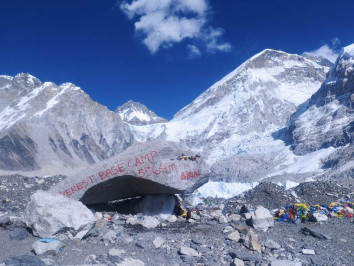
Altitude sickness on the Everest Base Camp trek is caused by ascending faster than your body can adapt to falling oxygen levels. Air pressure — and with it, the amount of oxygen in each breath — drops steadily above 2,500m. By Everest Base Camp at 5,364m, you're breathing air with roughly half the oxygen density of sea level. Your body can adjust to that, but it needs days, not hours.
The trouble is the route itself invites you to move faster than that. A typical EBC itinerary gains:
| Stop | Elevation | Gain from previous night |
|---|---|---|
| Lukla | 2,860m | — |
| Phakding | 2,610m | descent |
| Namche Bazaar | 3,440m | +830m |
| Tengboche | 3,860m | +420m |
| Dingboche | 4,410m | +550m |
| Lobuche | 4,940m | +530m |
| Gorak Shep | 5,164m | +224m |
| Everest Base Camp | 5,364m | day hike |
| Kala Patthar | 5,545m | day hike |
The Wilderness Medical Society's guidance is to gain no more than 500m of sleeping altitude per day above 3,000m, with a rest day every third or fourth day. Look at that table again — several of those jumps sit right at or above that limit. That's exactly why the built-in acclimatization days at Namche and Dingboche aren't padding. They're the itinerary doing its job.
What Altitude Sickness Actually Feels Like
Most competitor guides lump every symptom into one vague list. In practice, there's a real difference between "you should slow down" and "you need to descend tonight."
Mild AMS (Acute Mountain Sickness) — manageable with rest, usually resolves in 24–48 hours without further ascent:
- Headache, often the first sign
- Fatigue and loss of appetite
- Mild nausea or dizziness
- Trouble sleeping
Symptoms that mean stop ascending immediately and consider descent:
| Warning sign | What it points to |
|---|---|
| Headache that doesn't respond to paracetamol or ibuprofen | Worsening AMS |
| Vomiting, ataxia (loss of coordination, can't walk a straight line) | High Altitude Cerebral Edema (HACE) |
| Breathlessness at rest, persistent cough, gurgling sound in the chest | High Altitude Pulmonary Edema (HAPE) |
| Confusion or drowsiness that doesn't fit the person's usual character | HACE — this one moves fast |
A few operator blogs claim HACE and HAPE "can't happen" on the standard EBC route. That's not accurate, and it's the kind of reassurance that gets people hurt. Published studies from the Himalayan Rescue Association's Khumbu clinic put HAPE incidence at roughly 0.5–15% and HACE at around 1.3–1.8% among Nepal Himalaya trekkers, depending on the study and altitude band — low, but not zero, and both are genuinely life-threatening without prompt descent. What the data does support is that the risk climbs sharply with altitude: one Solu-Khumbu study found AMS incidence around 15% in the 4,000–4,500m band (roughly Dingboche) jumping to 51% between 4,500–5,000m (Lobuche to Gorak Shep territory). That's the stretch where we watch people most closely.
What Actually Prevents It — And What's Just Advice People Repeat
Gradual ascent is the only prevention method with real evidence behind it. Everything else helps at the margins:
- Hydration: 3–4 liters a day. Dry mountain air and faster breathing dehydrate you quicker than you'd expect, and dehydration mimics and worsens AMS symptoms.
- "Climb high, sleep low": on acclimatization days at Namche and Dingboche, a short hike up and back down before sleeping at the lower elevation genuinely helps your body adapt faster than a full rest day in bed.
- Alcohol and sleeping pills: both suppress breathing at altitude. Skip them entirely above 3,000m.
- Pulse oximeter checks: our guides check oxygen saturation and resting heart rate twice a day from Namche onward. A dropping SpO2 trend over two or three days tells us more than a single bad reading — it's a pattern worth acting on before symptoms show up.
Diamox — the honest version
Acetazolamide (Diamox) is widely used as a preventive medication, and the standard prophylactic dose cited in North American high-altitude medicine guidelines is 125mg twice daily, usually started a day before ascending above 2,500–3,000m. It works by encouraging faster breathing, which helps your body acclimatize sooner — it doesn't mask symptoms the way painkillers can. Side effects are common but mild: tingling fingers and toes, more frequent urination, and a metallic taste with carbonated drinks. It requires a prescription, so this is a conversation to have with your doctor before you fly to Kathmandu — not something to start on the trail because a guide suggested it.
What We Actually Do When a Client Shows Symptoms
This is the part most trekking sites skip, because it's not a selling point. It should be.
If a guide sees worsening AMS symptoms — a headache that isn't easing, appetite gone for more than a day, an oxygen reading trending down — the response is not to push on and see how the day goes. It's to stop ascending, rest at that elevation or descend, and reassess before continuing. If HACE or HAPE symptoms appear, descent starts immediately, day or night, regardless of how close base camp is or how much the trip cost. No itinerary, and no client's schedule, is worth overriding that call. We've had clients turn back at Dingboche and Lobuche who were disappointed in the moment and grateful within a day once the headache lifted at lower altitude.
The Himalayan Rescue Association runs a seasonal aid post at Pheriche (around 4,240m), staffed by volunteer high-altitude medicine doctors during spring and autumn, and has run daily AMS lectures there since 1973. If you're showing symptoms by Dingboche or Pheriche, that's a genuinely useful stop, not just a photo op.
Insurance and Evacuation — What to Actually Check
Standard travel insurance often excludes trekking above a certain altitude, or excludes helicopter evacuation specifically. Before you book, confirm your policy covers emergency helicopter evacuation from high altitude — ideally rated to at least 6,000m, which covers the full EBC route including Kala Patthar. We've broken down real policy options and costs in our travel insurance guide for Nepal trekking — it's worth reading before you buy, not after.
Choosing an Itinerary That Actually Lowers Your Risk
The single biggest risk factor we see isn't fitness — it's a compressed itinerary. A 9-day EBC trek and a 14-day one cover the same distance; the difference is acclimatization days, and that difference is where AMS risk concentrates. If you're weighing options, our standard Everest Base Camp Trek – 12 Days is built around the acclimatization schedule above rather than around shaving a day off the brochure. For trekkers who want even more gradual acclimatization built in — plus a genuinely different route back through the Gokyo valley — the Everest Three Pass Trek adds days precisely where altitude risk is highest. If EBC is your first high-altitude trek, that extra margin is worth more than it sounds like on paper. For a sense of how this compares to another high-altitude trek entirely, our Manaslu Circuit difficulty breakdown covers similar ground from a different angle.
FAQ
Is altitude sickness common on the Everest Base Camp trek? Yes. Published studies of trekkers in the Khumbu region report AMS incidence ranging from roughly 15% at Dingboche's altitude (around 4,300m) to over 50% above 4,500m. Most cases are mild and resolve with rest and proper pacing.
Can you get altitude sickness even if you're fit? Yes. Fitness affects how easily you can walk uphill, not how quickly your body acclimatizes to reduced oxygen. Marathon runners get AMS; unfit trekkers who ascend slowly often don't.
What is the highest point on the EBC trek? Kala Patthar, at 5,545m, is the highest point most trekkers reach — higher than Everest Base Camp itself, which sits at 5,364m.
Should I take Diamox before my trek? Talk to your doctor before you travel. The standard preventive dose used in high-altitude medicine is 125mg twice daily, started a day before ascending above 2,500–3,000m, but it requires a prescription and isn't right for everyone.
What happens if I develop severe symptoms on the trail? Descent starts immediately. For serious cases, or if descent isn't safe or fast enough, helicopter evacuation to Kathmandu is arranged — which is why altitude-rated travel insurance matters before you leave home.
Do acclimatization days actually matter, or are they just there to sell longer treks? They matter. The jump from Namche (3,440m) to Dingboche (4,410m) and beyond is exactly the range where published AMS incidence rises sharply — the days built in at Namche and Dingboche exist to slow that ascent rate down.
Is EBC more dangerous for altitude sickness than Annapurna Base Camp? Yes, meaningfully. ABC tops out around 4,130m, well below the 4,500m threshold where AMS incidence in Khumbu studies jumps sharply. EBC's route sits above that threshold for several days.
Ready to Trek Everest Base Camp?
Altitude sickness on the EBC trek is manageable, not mysterious — it responds predictably to pacing, hydration, and a guide who's willing to say "not today" when it matters. If you're planning your trek, get in touch with our team to talk through itinerary options, or reach us directly at annapurnaregion@gmail.com / info@annapurnaencounter.com.