


Clients ask this one more than almost any other trekking-peak question, and the honest answer is that Mera Peak vs Island Peak isn't really a difficulty contest — it's a question about what kind of first 6,000m summit you want. One is higher, quieter, and technically simpler. The other is lower, busier, and asks more of you in the final two hundred metres. Neither is the "beginner" peak and neither is the "hard" peak in any simple sense. Here's what actually separates them, drawn from how we run both trips.
Hand-picked itineraries
Recommended Trips
Related journeys you may want to explore after reading this article.
Quick Comparison
| Mera Peak | Island Peak | |
|---|---|---|
| Summit altitude | 6,470m | 6,160m |
| Alpine grade | F to PD (moderate, non-technical ascent) | PD+ (fixed-rope headwall near the summit) |
| Route character | Remote Hinku Valley, camping-based | Classic Everest Base Camp trail, teahouses until Chhukung |
| Our itinerary | 18 days, US$1,700pp | 16 days, US$3,000pp (includes a full EBC trek and Kala Patthar) |
| Best season | March–June, September–December | Spring and autumn |
| Crowds | Low — off the main trekking circuit | Higher — shares the EBC trail for most of the trip |
That price gap looks bigger than it is. Our Island Peak Climb package folds in a complete Everest Base Camp trek and a Kala Patthar sunrise before the climbing even starts — you're paying for two summits, not one. If you've already done EBC and just want the climb, our Island Peak Climbing base-camp-to-base-camp service is the leaner option built for exactly that.
Altitude and Acclimatization
Mera is genuinely higher — 6,470m against Island's 6,160m — and the approach reflects that. The Hinku Valley route climbs over Zatrwa La (4,600m) before dropping into a quieter, less-trekked valley, with a dedicated acclimatization day at Tagnag (4,360m) and two nights around 5,300m at Mera Base Camp before the final push from High Camp (5,780m). It's a longer, more gradual altitude profile precisely because there's no established teahouse infrastructure to fall back on if someone needs to descend quickly — the trek itself does more of the acclimatization work.
Island Peak's approach follows the standard Everest Base Camp Trek route through Namche Bazaar and Dingboche, both well-established acclimatization stops with proper lodges, before branching off to Chhukung and the Island Peak base camp. By the time climbers reach base camp, they've had the benefit of the EBC route's built-in rest days and, on our itinerary, the extra altitude exposure from the Kala Patthar side trip. If altitude is your main concern rather than technical climbing, Island Peak's approach gives you more infrastructure and support along the way.
Technical Difficulty: Where the Two Actually Diverge
This is the real dividing line, and it's not about which mountain is "harder" in general — it's about what kind of hard.
Mera Peak is graded F to PD on the French/Swiss Alpine system — a long, straightforward glacier walk on a gradual slope. You'll use crampons and an ice axe and rope up for glacier travel, but there's no vertical ice, no fixed-line ascent, and no exposed scrambling near the top. The difficulty on Mera is almost entirely about altitude, cold, and summit-day length rather than technical movement.
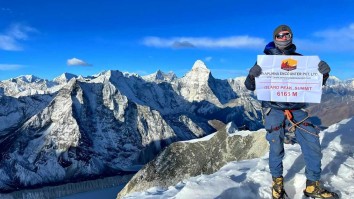
Island Peak is graded PD+, and the extra plus is doing real work. The final push to the summit involves a steep headwall requiring fixed ropes, and climbers need to be comfortable using jumar and basic ascending technique under load at altitude — not advanced mountaineering, but a genuine technical skill that Mera simply doesn't ask for. If you want an honest taste of real ice climbing before committing to something bigger, Island Peak gives you that; Mera doesn't.
That distinction matters more than the summit elevations do. A strong hiker with good fitness and no climbing background will likely find Mera more approachable end to end. Someone who wants to test whether they enjoy technical climbing — fixed ropes, ascenders, exposure — before investing in a bigger objective should lean toward Island Peak.
Which One Should You Climb First?
Choose Mera Peak if you want the higher summit and bragging rights that come with it, you'd rather avoid technical climbing on your first 6,000m peak, and a quiet, remote trail matters more to you than convenience or company along the way.
Choose Island Peak if you want to combine a trekking-peak summit with an Everest Base Camp trek in one trip, you're specifically looking to try technical climbing — fixed ropes, an ice headwall — before a bigger expedition, or you'd rather climb on a well-supported trail with established infrastructure at every stage.
Do both if you have the time. Climbers who've done one often come back for the other, and it's genuinely useful preparation if you're eyeing something like Ama Dablam or an 8,000m expedition down the line — Mera builds altitude tolerance and stamina, Island Peak builds technical confidence. Our Everest Three Peaks Climbing expedition combines Mera, Island, and Lobuche East in a single 30-day itinerary for climbers who want all three in one trip rather than two separate ones.
Season and Weather
Both peaks climb best in the same two windows: spring (March to May) for clear skies and stable snow conditions, and autumn (September to November) for crisp post-monsoon visibility and reliable weather. Mera's season extends a little further into early winter on our itinerary, since its remote approach sees far less crowding even in shoulder months. Island Peak, sharing the EBC trail, is busiest exactly when the trail itself is busiest — expect more company at Chhukung and base camp during peak spring and autumn weeks.
Frequently Asked Questions
Which is harder, Mera Peak or Island Peak? It depends what kind of difficulty you mean. Mera Peak is higher and demands more altitude endurance over a longer summit day. Island Peak is lower but technically harder, with a fixed-rope headwall near the summit that Mera doesn't have.
Do I need prior climbing experience for either peak? No prior technical climbing experience is required for either. Both are considered entry-level Himalayan climbing peaks, though a good level of trekking fitness and some altitude experience is strongly recommended for both.
How much does Mera Peak cost compared to Island Peak? Our Mera Peak Trek & Climb runs US$1,700 per person over 18 days. Our Island Peak Climb runs US$3,000 per person over 16 days, but that package includes a full Everest Base Camp trek and Kala Patthar summit beforehand — a base-camp-to-base-camp-only Island Peak service costs less.
Can beginners climb Island Peak? Fit trekkers with no prior technical climbing experience regularly summit Island Peak with proper guiding, training at base camp, and use of fixed ropes on the headwall. It is more technical than Mera Peak, so guided training before the summit push matters more.
Is Mera Peak or Island Peak more crowded? Island Peak, because its approach follows the popular Everest Base Camp trail for most of the trip. Mera Peak's Hinku Valley route is considerably quieter and sees far fewer trekkers.
What permits do I need for Mera Peak or Island Peak? Both require a trekking peak climbing permit issued by the Nepal Mountaineering Association, along with the relevant national park entry permit — Sagarmatha National Park for Island Peak's approach, and Makalu Barun National Park fees for sections of the Mera Peak route.
Can I combine Mera Peak and Island Peak in one trip? Yes. Our Everest Three Peaks Climbing expedition combines Mera Peak, Island Peak, and Lobuche East across a single 30-day itinerary for climbers who want more than one summit without planning separate trips.
Still deciding between the two? Get in touch with Annapurna Encounter and we'll talk through your fitness, experience, and timeline before you commit to either.