

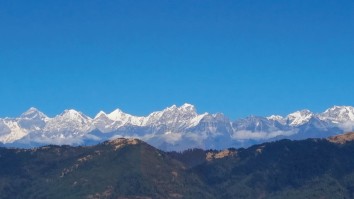
Sir Edmund Hillary reportedly called the sunrise from Pikey Peak his favorite view of Everest — better, by his own account, than the one from the mountain's own base camp. Almost nobody trekking in Nepal has heard of it. That's not an accident of marketing; it's a genuine gap in what most operators talk about, and it means you can stand at 4,065m looking at six 8,000m peaks without another trekking group in sight.
Hand-picked itineraries
Recommended Trips
Related journeys you may want to explore after reading this article.
What Makes Pikey Peak Different
Most treks toward Everest involve a flight to Lukla, a national park permit, and a trail shared with several hundred other trekkers a day in peak season. Pikey Peak involves none of that. You drive to Phaplu — no flight, no weather risk — trek through Sherpa, Tamang, and Magar villages in the lower Solu-Khumbu, and reach a summit that tops out well below the altitude where serious mountain sickness becomes a real concern.
It isn't a replacement for standing at Everest Base Camp itself. It's a different, shorter, cheaper way to see the same mountain, and for trekkers who are short on time, wary of altitude, or simply want fewer people on the trail, it's a genuinely honest alternative rather than a consolation prize.
Pikey Peak Trek Difficulty
We grade this trek moderate — the same rating we give Ghorepani Poon Hill, and easier than any Everest Base Camp itinerary. The trail climbs steadily through rhododendron, oak, and pine forest with no single brutal day, and the itinerary is built to control daily altitude gain deliberately, since the whole point of the route is to keep the risk profile low.
That said, "moderate" isn't "easy." Day 5, from Pikey Peak Base Camp to Jhapre, involves an early pre-dawn summit push followed by a long descent over rough terrain — a demanding day for first-time trekkers, even if it's short by Himalayan standards. Five to seven hours of daily walking over six trekking days is the realistic expectation, not a leisurely stroll.
Pikey Peak Trek Cost
| Group Size | Regular Package | Premium Package |
|---|---|---|
| Solo (1 person) | USD 950 | USD 1,520 |
| 2 people | USD 890 | USD 1,420 |
| 3–7 people | USD 840 | USD 1,320 |
| 8–12 people | USD 800 | USD 1,220 |
The Regular Package starts from USD 760 per person for larger groups and covers tea house accommodation, all trekking meals, a licensed guide, a shared porter, and two nights in a Kathmandu hotel. The Premium Package starts from USD 1,120 and adds upgraded lodges, a dedicated porter with a higher baggage allowance, and staff insurance. For comparison, that's roughly a third of what a standard 12-day Everest Base Camp trek costs — the lower price isn't a corner-cutting exercise, it's what a shorter route with no restricted-area permit and no domestic flight actually costs to run.
Itinerary Overview
| Day | Route | Elevation |
|---|---|---|
| 1 | Drive Kathmandu → Phaplu (7 hrs) | 2,475m |
| 2 | Trek Phaplu → Junbesi (6 hrs) | 2,830m |
| 3 | Trek Junbesi → Lamjura (6 hrs) | 3,500m |
| 4 | Trek Lamjura → Pikey Peak Base Camp (5 hrs) | 3,640m |
| 5 | Summit Pikey Peak, trek to Jhapre (5–6 hrs) | 4,065m |
| 6 | Trek Jhapre → Dhap (4 hrs) | 2,920m |
| 7 | Drive Dhap → Kathmandu (6 hrs) | — |
No day above 4,100m. No overnight above 3,640m. That combination is precisely why altitude sickness is a minor concern here compared to almost any other trek toward the Everest region.
Permits: What You Don't Need
This is where Pikey Peak earns its price tag. There's no Sagarmatha National Park fee, no restricted-area permit, and no Annapurna Conservation Area fee, since the route sits outside all three protected zones. You need only a TIMS card and a local municipality trekking fee — both arranged by your agency before departure. That's a genuinely simpler paperwork process than almost any other Everest-region route on this site.
Best Season
Autumn (September–November) and spring (March–May) are the strongest windows, with clear skies and the best odds of an unobstructed sunrise from the summit. Because the trek tops out well under 4,100m, the shoulder months work here in a way they don't on higher routes — you're not fighting altitude-related closures the way you would above 5,000m. Monsoon (June–August) is a different story: heavy rain, leeches on the lower forested sections, and a real landslide risk make it a season to avoid regardless of altitude. Winter is possible, but expect closed teahouses at the higher points and genuinely cold nights.
Frequently Asked Questions
How difficult is the Pikey Peak trek? Moderate. The trail involves five to seven hours of daily walking with no single extreme day, though the pre-dawn summit push on Day 5 is demanding. It's easier than any Everest Base Camp itinerary and comparable to Ghorepani Poon Hill.
How much does the Pikey Peak trek cost? The Regular Package starts from USD 760 per person for larger groups, rising to USD 950 for solo trekkers. The Premium Package starts from USD 1,120.
Do I need a permit for the Pikey Peak trek? Only a TIMS card and a local municipality trekking fee. No national park permit or restricted-area permit is required, since the route falls outside those protected zones.
Is the Pikey Peak trek as good as Everest Base Camp for mountain views? It's a different view, not a lesser one. You won't stand at the foot of Everest itself, but the panorama from the summit — including Everest, Makalu, Dhaulagiri, and Kanchenjunga — is genuinely exceptional for a fraction of the altitude, cost, and time.
Do I need to fly to do the Pikey Peak trek? No. The trek starts and ends with a road drive between Kathmandu and Phaplu — no domestic flight is involved at any point.
What's the highest point on the Pikey Peak trek? Pikey Peak itself, at approximately 4,065m — well below the altitude where serious mountain sickness typically becomes a concern.
How many days is the Pikey Peak trek? Seven days including the drives on both ends, with five trekking days between Phaplu and Dhap.
If a lower-altitude, lower-cost route to an Everest view sounds right for your dates, see the full Pikey Peak Trek itinerary or talk to us about combining it with a longer Everest Base Camp Trek if you'd rather do both.