
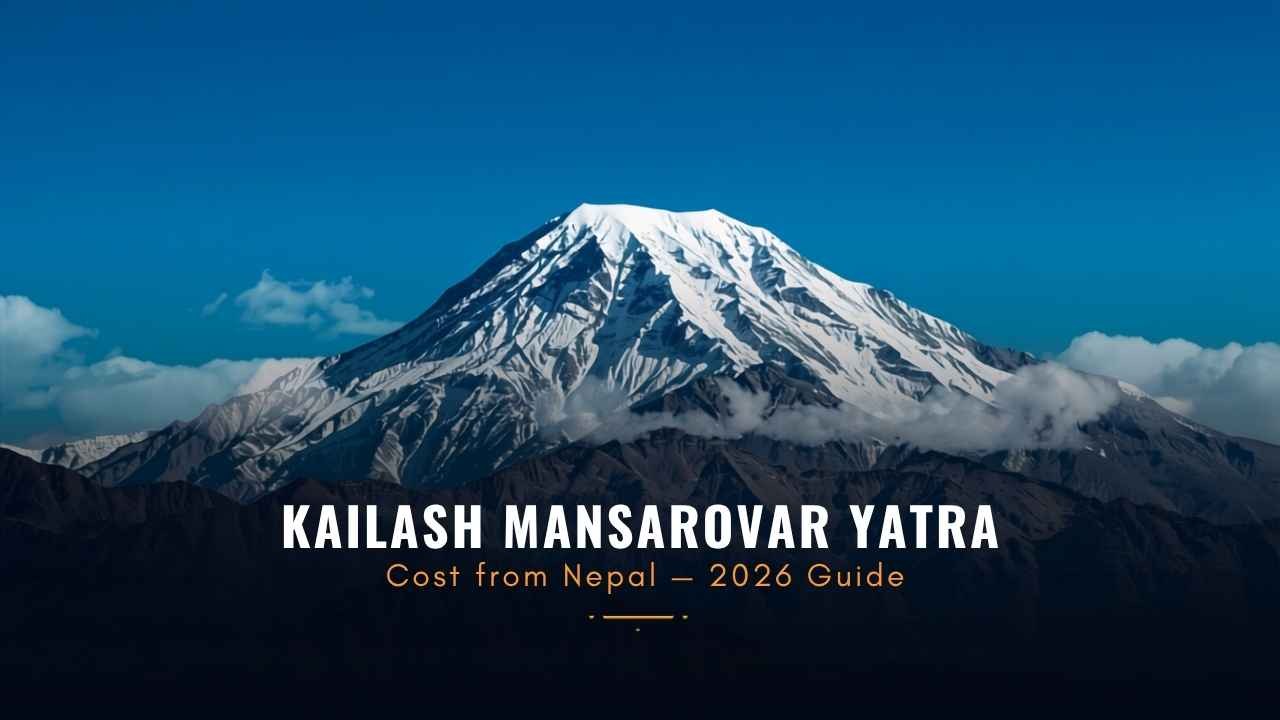
Mount Kailash sits at 6,638 m on the far western Tibetan Plateau — a black rock pyramid that has never been climbed and, by Chinese government prohibition, never will be. Hindus revere it as Shiva's throne, Buddhists as the seat of Chakrasamvara, Jains as Mount Ashtapada, Bön practitioners as the source of all spiritual power. For roughly 1.5 billion people across four religions, this is the holiest mountain on earth.
Hand-picked itineraries
Recommended Trips
Related journeys you may want to explore after reading this article.
The Nepal-departure route runs overland from Kathmandu through the Kyirung (Gyirong) border crossing into Tibet, across the plateau to Lake Manasarovar (4,600 m), then to Darchen for the three-day, 52 km Kailash Kora — the circumambulation that crosses Dolma La Pass at 5,630 m, the highest and hardest point of the pilgrimage. It's a 10-day round trip from Kathmandu, drive-in and drive-out, no flights inside Tibet required.
Why the Cost Range Is So Wide
Three things move the price more than anything else:
- Route. Overland via Kyirung is the standard, most affordable way in from Nepal. The alternative — flying Kathmandu–Nepalgunj–Simikot, then helicoptering Simikot to Hilsa on the Tibet border — cuts days off the trip but adds two internal flights and a helicopter leg, both weather-dependent and both expensive. We don't currently run the Simikot–Hilsa helicopter route ourselves; if that's what you're pricing, treat any quote as separate from the overland figures below.
- Meal plan and room category. Bed-and-breakfast versus full board, twin-share versus single supplement, guesthouse versus the handful of better lodges on the plateau — this alone accounts for several hundred dollars of spread between otherwise identical itineraries.
- What's actually included. This is where quotes get misleading. Insurance, emergency helicopter evacuation, porter or yak hire on the Kora, and the Nepal-side hotel nights are excluded from almost every published price — including ours — but not every operator says so clearly upfront.
What Our 10-Day Kailash Tour Actually Costs
We run this as a small-group, fixed-departure tour from Kathmandu, two package tiers:
| Package | Price per person | Meal plan | Group size |
|---|---|---|---|
| Budget | USD 1,700 | Breakfast only (Kathmandu–border–Kathmandu) | Small group, guaranteed departure |
| Standard | USD 2,000 | Full board throughout | Small group, guaranteed departure |
Both prices are twin-sharing; a single supplement applies for solo occupancy. If you're comparing this to the USD 2,500–4,500 range you'll see quoted for overland Kailash tours elsewhere, the gap usually comes down to group size and margin, not missing corners — our permits, guide, and transport are the same government-mandated arrangements every legitimate operator has to use. We'd rather show you the real number than pad a quote to look more "premium."
What's Included
- Hotel/guesthouse accommodation for all 10 days as per the itinerary
- Private transportation by van or mini-coach, Kathmandu to the border and throughout Tibet
- All required Tibet travel and trekking permits (Tibet Travel Permit, Alien's Travel Permit, Military Permit, Kailash Area Permit)
- English-speaking Tibetan guide for the full route
- Sightseeing and monastery entrance fees per the itinerary
- Meals as per package (breakfast only on Budget; full board on Standard)
What's Excluded
- Travel insurance of any kind
- Porter, yak, or horse hire on the Kailash Kora (available at Darchen, roughly USD 20–30/day, arranged on request)
- Emergency rescue and evacuation service
- Nepal visa fee, international flights to Kathmandu, and personal expenses
- Any additional cost from natural events or unforeseen circumstances
That last exclusion isn't boilerplate. Tibet periodically restricts foreign entry — most commonly around March — and permit availability can shift with little notice. If Tibet is officially closed and we can't obtain permits, we issue a full refund; we don't hold deposits against government-caused closures.
Permits: What They Actually Are
Unlike Nepal's Annapurna Conservation Area Permit (ACAP-style paperwork), the Kailash permit stack is entirely Chinese government process, applied for from Kathmandu:
- Chinese Group Tourist Visa — issued as a separate group document, not a stamp in your passport. If you already hold an individual Chinese visa, it gets invalidated once the group visa is issued.
- Tibet Travel Permit (TTP) — required to fly or drive into Tibet at all.
- Alien's Travel Permit — required for travel beyond Lhasa into restricted border areas, which Kailash sits within.
- Military Permit — required specifically for the Kailash–Mansarovar border belt, given its proximity to the India and Nepal frontiers. This is the slowest of the four to process and the one most likely to hold up a departure if applied for late.
We handle all four as part of the package price. What we can't control is Chinese government processing time or sudden regional closures — which is why we recommend booking at least 2–3 months ahead of a May–October departure, earlier if you can.
A note for Indian nationals: the standard Chinese group visa process above doesn't apply to you. Indian citizens travel either through the Indian government's official Kailash Mansarovar Yatra (KMY) programme via the Ministry of External Affairs, or via a separate overland arrangement — not the Nepal group-visa route described here. If you're an Indian passport holder, tell us before booking so we can point you to the right process rather than a Kailash package that won't clear immigration.
Best Season
May–June and September–October are the two solid windows. May–June sometimes overlaps with the Saga Dawa festival, the holiest month in the Tibetan Buddhist calendar — completing the Kora during Saga Dawa is traditionally believed to multiply its spiritual merit thirteenfold, and it's also when the plateau is busiest. September–October brings the clearest post-monsoon skies and the best mountain visibility of the year.
July–August is possible but riskier — not because of Tibet itself, but because Nepal's monsoon can disrupt the Kyirung road on the Nepal side. November through April is effectively closed: temperatures on the plateau can drop below −30°C, the Kyirung road is regularly snowbound, and Tibet doesn't run group tours in winter.
Difficulty
This isn't a technical trek, but it's not an easy one either. Most of the 10 days are spent above 4,500 m, where blood oxygen saturation runs at roughly half of sea-level normal. A peer-reviewed study on high-altitude trekkers found Acute Mountain Sickness affects close to half of travellers spending time at 4,500–5,000 m — exactly the band this trip lives in. The Kora itself covers 52 km over three days, including a 6–7 hour, 18 km day that crosses Dolma La at 5,630 m — the hardest single day of the pilgrimage, done on foot regardless of age or fitness level, because no vehicle reaches that pass.
You should be comfortable walking 15–18 km a day carrying a light daypack, and we'd recommend 4–6 weeks of cardio preparation beforehand if you're not already active. Travellers over 60 should bring a recent medical clearance, and anyone with an unmanaged heart or lung condition should talk to a doctor before booking. Travel insurance with a minimum USD 100,000 high-altitude medical evacuation limit is mandatory for everyone on this trip — not a suggestion, a condition of joining the group.
If the spiritual and physical scale of Kailash appeals to you but you'd also like to see Everest, our Tibet Kailash Mansarovar Yatra with EBC Tour combines both in a single 14-day itinerary, and the Mount Kailash and Lhasa Tour adds Lhasa's monasteries and the Potala Palace to the pilgrimage for those who want the cultural side of Tibet alongside Kailash itself.
FAQ
How much does the Kailash Mansarovar Yatra cost from Nepal? Our 10-day fixed-departure tour from Kathmandu costs USD 1,700 per person on the Budget package (breakfast only) or USD 2,000 on the Standard package (full board), both twin-sharing. Insurance, evacuation cover, and porter/yak hire on the Kora are excluded from both.
What's the difference between the overland and helicopter routes? The overland route drives from Kathmandu through the Kyirung border to Lake Manasarovar and Darchen — this is what we operate, over 10 days. The helicopter route flies Kathmandu–Nepalgunj–Simikot, then helicopters Simikot to Hilsa on the Tibet border, cutting the trip to roughly 9–12 days but adding weather-dependent flights and typically several thousand dollars to the cost.
Do I need a Nepal visa for this trip? Yes, if you're not Nepali or Indian. A Nepal tourist visa (available on arrival for most nationalities, roughly USD 30 for 15 days) is required before you can begin the Tibet permit process from Kathmandu, and it isn't included in the Kailash package price.
Can I do the Kailash Kora without prior trekking experience? Yes, for most healthy adults. The Kora is a well-established pilgrimage trail, not a technical route — the challenge is altitude, not terrain. Your guide monitors everyone's condition throughout and adjusts pace accordingly.
What currency do I need in Tibet? Chinese Yuan (CNY). US dollars aren't accepted at most guesthouses or shops on the plateau. Exchange money in Kathmandu or at Kyirung before crossing — ATMs beyond the border are unreliable.
Is travel insurance really mandatory? Yes. We require a minimum USD 100,000 high-altitude medical evacuation limit for every traveller on this trip, no exceptions. Close to half of travellers spending extended time above 4,500 m experience some degree of altitude sickness, and evacuation from the Kailash region is a serious undertaking if it's needed.
What if Tibet closes to foreign visitors before my departure? If Chinese authorities close Tibet and we can't obtain permits, we issue a full refund. We monitor Tibet Tourism Bureau announcements and notify confirmed bookings as soon as anything changes.
Ready to Plan Your Yatra?
Permits for this route take time to process and departures fill up, particularly for the May–June Saga Dawa window and the September–October clear-sky season. Reach out to us at annapurnaregion@gmail.com or info@annapurnaencounter.com, or view fixed departure dates and book directly — we'll walk you through which package and season fits your plans.