
The Annapurna Base Camp trek is consistently the cheaper of Nepal's two flagship treks, and the reason is mechanical, not marketing: no domestic flight to a mountain airstrip, a shorter standard itinerary, and lower permit fees. That doesn't mean every quote you'll see is honest about what's included. Here's exactly what drives the number, and what we charge per group size and service tier.
Hand-picked itineraries
Recommended Trips
Related journeys you may want to explore after reading this article.
.jpg)
-1.jpg)
Trip Overview
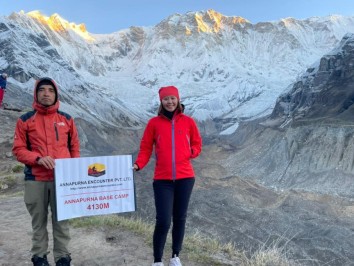
The Annapurna Base Camp trek climbs to 4,130m inside the Annapurna Sanctuary, a glacial amphitheatre ringed by Annapurna I, Machhapuchhre, and Hiunchuli. The standard route runs 9–12 days starting and ending in Pokhara, with a natural hot-spring stop at Jhinu Danda on the way out — a detail that matters when you're comparing it to the longer, colder Everest Base Camp route.
Why ABC Costs Less Than Everest Base Camp
Three structural differences explain most of the gap. First, there's no expensive, weather-prone domestic flight — ABC starts with a drive or short flight to Pokhara, both far cheaper and more reliable than the Kathmandu–Lukla route. Second, the standard itinerary is shorter, which means fewer paid guide, porter, and lodging days. Third, the Annapurna Conservation Area Permit is a single, modest fee compared to the two-permit system in the Khumbu. None of this makes ABC an "easier sell" trek — it's simply a structurally cheaper one.
Annapurna Base Camp Trek Cost by Category
| Cost item | Typical range (per person) | Notes |
|---|---|---|
| Kathmandu–Pokhara transport | $10–$150 | Tourist bus from $10–15; private jeep or domestic flight cost more |
| Annapurna Conservation Area Permit (ACAP) | NPR 3,000 (approx. $23–30) | Fixed government fee, required for all foreign trekkers |
| Licensed guide | $25–$40/day | Mandatory since a 2023 rule requiring guides across Annapurna routes |
| Porter | $15–$25/day | Usually 1 porter per 2 trekkers |
| Teahouse lodging | $4–$15/night | Cheaper than Everest region equivalents at similar altitude |
| Meals on trek | $20–$30/day | Rises above Chhomrong, though less steeply than in the Khumbu |
| Travel insurance with altitude evacuation | $100–$200 for the trip | Mandatory; standard travel insurance won't cover 4,130m |
Our Annapurna Base Camp Trek Cost — Group Pricing (Per Person, USD)
Based on the standard 12-day Annapurna Base Camp trek from Kathmandu.
| Group Size | Standard Package | Premium Package |
|---|---|---|
| 1 (Solo) | $1,199 | $2,000 |
| 2 People | $1,100 | $1,900 |
| 3–7 People | $1,000 | $1,850 |
| 8–12 People | $950 | $1,800 |
| 13–20 People | $900 | $1,750 |
Standard covers 3-star hotels in both Kathmandu and Pokhara, tea house accommodation on trek, all trek meals, guide, shared porter, and the ACAP permit. Premium upgrades to 4–5-star hotels in both cities, the best available lodges with attached bathrooms where possible, a senior high-altitude guide, higher porter baggage allowance, and flights between Kathmandu and Pokhara instead of the road journey.
What's Included (Standard Package)
- 2 nights 3-star hotel in Kathmandu with breakfast
- 2 nights 3-star hotel in Pokhara with breakfast
- Twin-sharing tea house accommodation during the trek
- Tourist bus, Kathmandu ↔ Pokhara
- Private/local jeep transfers to the trailhead and back
- All trek meals (breakfast, lunch, dinner, tea/coffee)
- Licensed English-speaking trekking guide
- Porter service, one porter per two trekkers (15–20kg allowance)
- Annapurna Conservation Area Permit (ACAP)
- First aid kit with oximeter
What's Not Included
- Lunch and dinner in Kathmandu and Pokhara
- Personal trekking equipment — rentable in Kathmandu
- Hot showers, Wi-Fi, and device charging in lodges (paid locally)
- Travel insurance with altitude evacuation coverage — mandatory
- International flights and Nepal entry visa
- Alcohol, bottled water, snacks
- Tips for guide, porter, and driver
- Costs from delays or weather disruption
The Costs Nobody Mentions Upfront
Village facilities climb with altitude. Wi-Fi, hot showers, and charging are all pay-as-you-go once you're on the trail, and the price rises the higher you climb. Expect roughly $2–3 for Wi-Fi and a hot shower at Ghandruk or Chhomrong, climbing to $4–5 for the same at Annapurna Base Camp itself, where everything is carried in on someone's back. A power bank charged before you leave Pokhara pays for itself in two days.
Tips. Not built into any package. Budget $150–$250 per trekker for guide and porter tips combined across a standard trek — the shorter duration compared to EBC means this line item is proportionally smaller, but it's still real money.
Single supplement. A solo trekker on the Standard package pays $1,199 against the $900 group rate for 13–20 people — a meaningful gap for a trek this length. If you can slot into a fixed departure, it's the single cheapest lever available to you.
Ways to Trek ABC for Less
If 12 days is more time and money than you want to spend, the 7-day Annapurna Base Camp trek compresses the same destination into a faster, cheaper itinerary for trekkers with solid fitness. The 5-day fast-track option from Pokhara goes further still, cutting the Kathmandu legs entirely for trekkers already in Pokhara or short on time. As with Everest, joining a fixed group departure rather than a private trip is the biggest single cost lever — moving from solo to a 13-person group saves close to $300 per person on the Standard package.
When the Premium Package Is Worth It
At 4,130m the difference between a standard teahouse room and an upgraded one with an attached bathroom is real, especially after a wet monsoon or cold winter trekking day. The bigger value in the Premium tier, though, is the senior guide — someone who has made the acclimatization call above Deurali enough times to know when a client needs an extra rest day rather than encouragement to push on. If your schedule allows it, this is where the premium earns its price difference more than in the hotel upgrade alone.
Best Season and How It Moves the Price
Autumn (October–November) is the clearest and most crowded season, and lodge rates sit at the top of the range. Spring (March–May) runs a close second, with blooming rhododendron forests as a bonus. Winter (December–February) is colder at altitude but quieter and cheaper, and monsoon (June–September) is lush, humid, and the least expensive — though leeches and cloud cover are the honest trade-off. Compared to Everest Base Camp, ABC's lower maximum altitude makes winter and monsoon genuinely more viable options here, not just a discount season for the desperate.
Permits Explained
The Annapurna Base Camp trek requires one core document: the Annapurna Conservation Area Permit (ACAP), a fixed government fee of NPR 3,000 (roughly $23–30 depending on the exchange rate). A licensed guide is mandatory under a rule enforced since April 2023 — independent solo trekking is no longer permitted on this route. The status of the TIMS card for Annapurna routes is genuinely unsettled as of 2026: some agencies still issue and carry it alongside the ACAP, others report it's no longer checked on standard ABC routes, and official guidance itself has been inconsistent. Rather than pretend there's a clean answer, we register you for both documents your route requires and confirm the current requirement with you directly before departure — worth doing with any agency you book through, since this is one of the few areas of real ambiguity in Nepal's permit system right now.
Frequently Asked Questions
How much does the Annapurna Base Camp trek cost per person? For a group of 13–20 trekkers, the Standard package costs $900 per person; a solo trekker on the same package pays $1,199. Premium packages range from $1,750 to $2,000 depending on group size.
Why is Annapurna Base Camp cheaper than Everest Base Camp? No expensive domestic flight is required, the standard itinerary is shorter, and the single ACAP permit costs less than the two-permit system required for Everest Base Camp.
Does the ABC trek cost include a guide? Yes, in every Annapurna Encounter package. A licensed guide is also legally mandatory on Annapurna routes as of a 2023 regulation.
Is the TIMS card required for Annapurna Base Camp? Its status is genuinely unsettled as of 2026 — some routes and agencies still require it, others don't enforce it. Confirm directly with your agency before departure rather than relying on older blog posts that state it flatly either way.
What's the cheapest way to do the Annapurna Base Camp trek? Join a fixed group departure of 8 or more trekkers on the Standard package, and consider the 7-day itinerary if your fitness allows a faster pace — both meaningfully reduce the per-day cost.
Is travel insurance included in the price? No. Insurance with high-altitude evacuation coverage is mandatory for the trek but never bundled into a package, since coverage needs vary by traveler and nationality.
Plan Your Trek
Every Annapurna Encounter Annapurna Base Camp package includes the ACAP permit, a licensed guide, and full trek-day meals, priced transparently before you book. Get a personalized quote for your Annapurna Base Camp trek and we'll walk you through Standard versus Premium based on your dates and group size.