

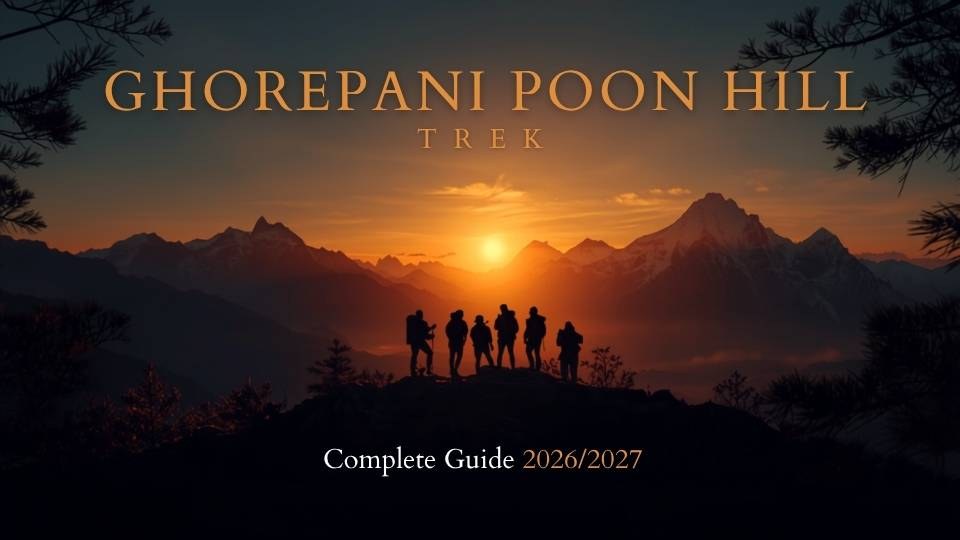
Quick answer: The Ghorepani Poon Hill Trek is a 4–7 day trek in Nepal's Annapurna region, topping out at 3,210m on Poon Hill, famous for its sunrise panorama over the Annapurna and Dhaulagiri ranges. It's rated easy to moderate, needs no prior trekking experience, and costs US$300 to US$1,250 per person depending on group size and service level. It's widely considered the best short introduction to Himalayan trekking — and the second most popular trek in the Annapurna region after Annapurna Base Camp.
Hand-picked itineraries
Recommended Trips
Related journeys you may want to explore after reading this article.

.jpg)
If you've got limited time in Nepal but still want a genuine Himalayan sunrise over 8,000m peaks, this is very likely the trek people are talking about. Here's everything you need to plan it.
What Is the Ghorepani Poon Hill Trek?
The Ghorepani Poon Hill Trek — also called the Poon Hill Trek or Annapurna Panorama Trek — is a short trekking route through the foothills of the Annapurna Conservation Area, starting and ending near Pokhara. The trail climbs through terraced farmland, rhododendron forests, and traditional Gurung and Magar villages to Poon Hill, a viewpoint at 3,210m offering an unobstructed 180-degree panorama of Annapurna (7,219m), Dhaulagiri (8,167m), Machhapuchhre "Fishtail" (6,993m), Hiunchuli, and Annapurna South.
Because it stays below 3,300m and involves no technical terrain, it's the trek most often recommended to families, first-timers, and travelers who want serious mountain views without committing to a multi-week, high-altitude expedition.
Ghorepani Poon Hill Trek Cost
Here's what the 7-day Ghorepani Poon Hill Trek costs per person with Annapurna Encounter, based on group size:
| Group Size | Budget Package | Standard Package | Premium Package |
|---|---|---|---|
| Solo (1 person) | US$ 450 | US$ 850 | US$ 1,250 |
| 2 people | US$ 400 | US$ 750 | US$ 1,100 |
| 3–7 people | US$ 350 | US$ 700 | US$ 950 |
| 8–12 people | US$ 325 | US$ 650 | US$ 900 |
| 13–20 people | US$ 300 | US$ 600 | US$ 850 |
- Budget package: licensed guide, ACAP permit, TIMS card, local buses Kathmandu–Pokhara–Nayapul, and twin-sharing tea-house stays — meals paid directly at lodges.
- Standard package: adds all trek meals, a porter (shared between two trekkers), 3-star hotels with breakfast in Kathmandu and Pokhara, and private vehicle transfers to Nayapul.
- Premium package: 4–5-star hotels, flights between Kathmandu and Pokhara, a senior guide, loaner trekking gear, daily oximeter checks, and welcome/farewell dinners.
Because the trek is short and low-altitude, it's one of the most affordable full Himalayan experiences in Nepal — noticeably cheaper than the Annapurna Circuit or Annapurna Base Camp Treks, both of which run longer at higher elevation.
Ghorepani Poon Hill Trek Itinerary
The classic route runs 4 to 7 days, depending on whether you start directly from Pokhara or include Kathmandu transfer days. Here's the standard 7-day itinerary:
| Day | Route | Altitude |
|---|---|---|
| 1 | Drive/fly to Pokhara | 950m |
| 2 | Drive to Nayapul, trek to Tikhedhunga | 1,450m |
| 3 | Trek to Ghorepani (via Ulleri's stone steps) | 2,874m |
| 4 | Sunrise hike to Poon Hill, trek to Tadapani | 3,210m → 2,721m |
| 5 | Trek to Ghandruk (Gurung village) | 2,012m |
| 6 | Trek to Nayapul, drive to Pokhara | 950m |
| 7 | Drive/fly back to Kathmandu | 1,350m |
The heart of the trek is Day 4: a pre-dawn climb to Poon Hill to watch sunrise light up the Annapurna and Dhaulagiri massifs — the single most-photographed moment on this route. From there, the trail loops back through Tadapani and the large Gurung village of Ghandruk, home to a Gurung culture museum and generations of Gorkha regiment soldiers, before returning to Pokhara.
Shorter 4-day and 5-day versions exist, cutting the Kathmandu transfer days and the Ghandruk loop for trekkers on a tighter schedule.
How Difficult Is the Ghorepani Poon Hill Trek?
The trek is rated easy to moderate — the most beginner-friendly multi-day trek in the Annapurna region. There's no technical climbing and no risk of altitude sickness at the 3,210m ceiling, but the route does include a genuinely demanding stretch: roughly 3,300 stone steps climbing to Ulleri on Day 3, which surprises a lot of first-timers. Outside of that section, daily walks run 5–6 hours on well-maintained trails.
A basic level of fitness — the ability to walk 5–6 hours a day on uneven terrain — is all that's required. No prior trekking experience is necessary, which is why this route is so often recommended for families with older children and first-time visitors to Nepal.
Permits Required
Every trekker needs the Annapurna Conservation Area Permit (ACAP) — NPR 3,000 (roughly US$22–25) for foreign nationals, NPR 1,000 for SAARC nationals — plus a TIMS card, issued through a registered trekking agency. Both are included in every Annapurna Encounter package, so you won't need to queue at the Nepal Tourism Board office yourself. Since 2023, a licensed guide is required for all foreign trekkers in the Annapurna Conservation Area.
Best Time for the Ghorepani Poon Hill Trek
Autumn (September–November) and spring (March–May) are the two prime seasons:
- Autumn brings the clearest skies of the year — the most reliable window for that unobstructed Poon Hill sunrise.
- Spring blankets the trail in blooming rhododendron forest, Nepal's national flower, especially vivid around Ghorepani and Tadapani.
- Winter (December–February) is quieter and colder, with occasional snow near Poon Hill, but the trek remains accessible and rewards trekkers with crisp, clear panoramas.
- Monsoon (June–August) brings lush greenery and fewer crowds but a higher chance of cloud cover blocking the sunrise view — the main trade-off to weigh against this season.
What to Pack for the Ghorepani Poon Hill Trek
- Clothing: warm layers for the pre-dawn Poon Hill climb, a waterproof shell, quick-dry trekking clothes, a warm hat and gloves
- Footwear: broken-in trekking boots (the stone steps to Ulleri are unforgiving in poor footwear)
- Gear: headlamp (essential for the pre-sunrise ascent), trekking poles, a 30–40L daypack, water bottle
- Essentials: sunscreen, sunglasses, basic first-aid kit, insect repellent, personal medication
Because the trek stays under 3,300m, you don't need the heavy-duty down jackets or -20°C sleeping bags required for higher routes like the Annapurna Circuit or EBC — a real cost and packing advantage for shorter trips.
Frequently Asked Questions
How long is the Ghorepani Poon Hill Trek? It's typically 4 to 7 days, depending on whether you start from Pokhara directly or include Kathmandu transfer days and the Ghandruk loop.
What is the highest point of the trek? Poon Hill at 3,210m (10,531 ft), reached on a short pre-dawn hike from Ghorepani village.
Is the Ghorepani Poon Hill Trek suitable for beginners? Yes — it's widely considered the most beginner-friendly multi-day trek in the Annapurna region, requiring only basic fitness and no prior trekking experience.
How much does the Ghorepani Poon Hill Trek cost? Between US$300 and US$1,250 per person, depending on group size and whether you choose a budget, standard, or premium package.
Do I need a permit for this trek? Yes — the Annapurna Conservation Area Permit (ACAP) and a TIMS card are both required, and are included in every guided package.
Can I do the Ghorepani Poon Hill Trek with children? Yes, it's one of the few Himalayan treks genuinely suitable for families, thanks to its low altitude ceiling and manageable daily walking hours.
Is the Ghorepani Poon Hill Trek better than Annapurna Base Camp for a short trip? If your priority is a quick, low-altitude Himalayan sunrise experience, Poon Hill is the better fit. If you want to stand inside the Annapurna Sanctuary at 4,130m surrounded by 8,000m peaks and have a bit more time, Annapurna Base Camp is the deeper — and longer — experience.
Final Thoughts
The Ghorepani Poon Hill Trek delivers one of the best sunrise views in the Himalayas for a fraction of the time, altitude, and cost of longer treks like the Annapurna Circuit or Everest Base Camp. For trekkers short on time, traveling with family, or trying Himalayan trekking for the first time, it's hard to beat.
For an accurate quote based on your travel dates and group size, get in touch with Annapurna Encounter directly.